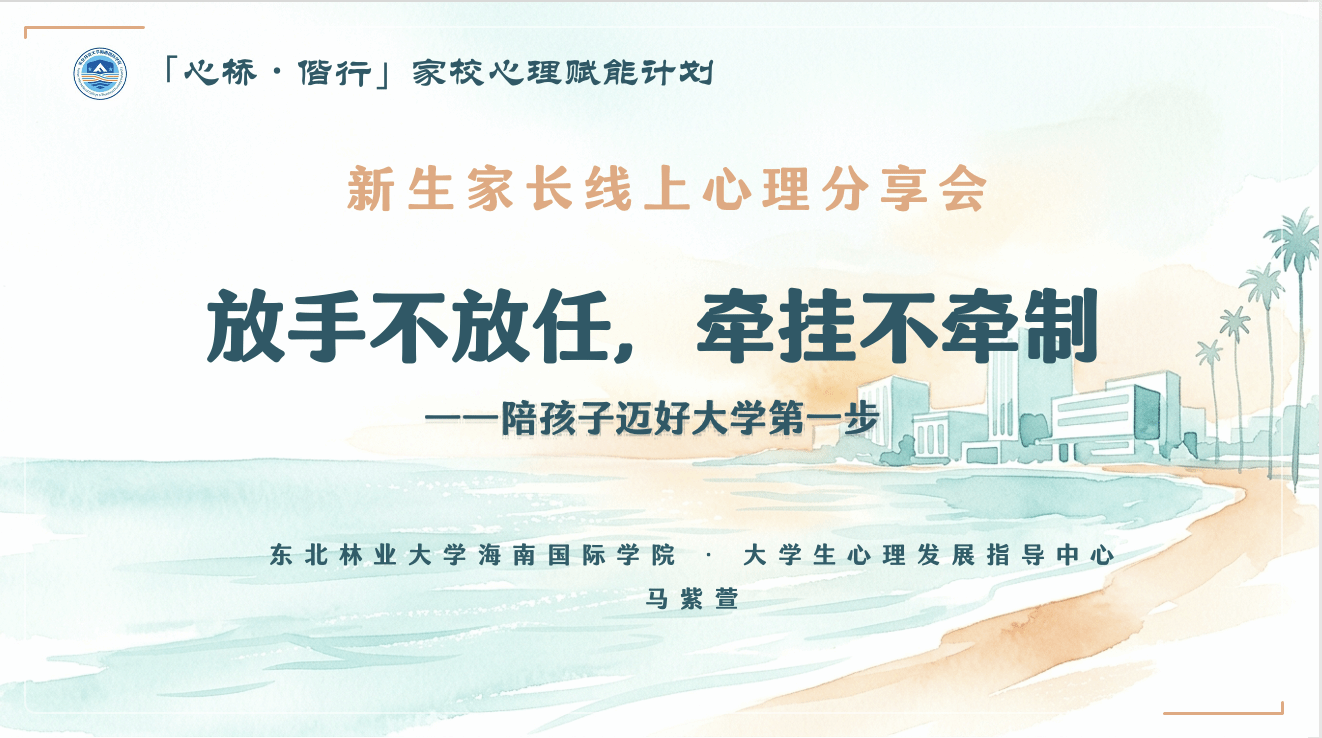
To build a multi-party collaborative support network for student mental health education, establish regular communication channels between family and school, empower students in their independent growth, and promote their all-round healthy development, Hainan International College held a warm and heartfelt online mental health sharing session for parents of the 2026 freshmen on 20 September.
Zixuan MA, a full-time psychological counselor at the University's Student Psychological Development Guidance Center, delivered the session under the theme "Letting Go without Letting Loose, Caring without Controlling: Accompanying Children in Taking Their First Step into University," integrating mental health education into the framework of collaborative education involving family, school, and society. Drawing on ego psychology and the stage theories of developmental psychology, she analyzed the practical challenges and psychological adaptation of both students and parents during the freshman transition period; shared parent–child communication methods and cognitive adjustment approaches suited to this stage; highlighted the key points for identifying psychological crises; and interpreted the university's mental health services, the supportive role of families, and social psychological support resources, so as to build a family–school–community linked psychological protection system. As the opening lesson of the College's "Heart Bridge · Walking Together" family–school psychological empowerment program, the session helped parents understand their children — and themselves — while conveying a science-based philosophy of psychological education.
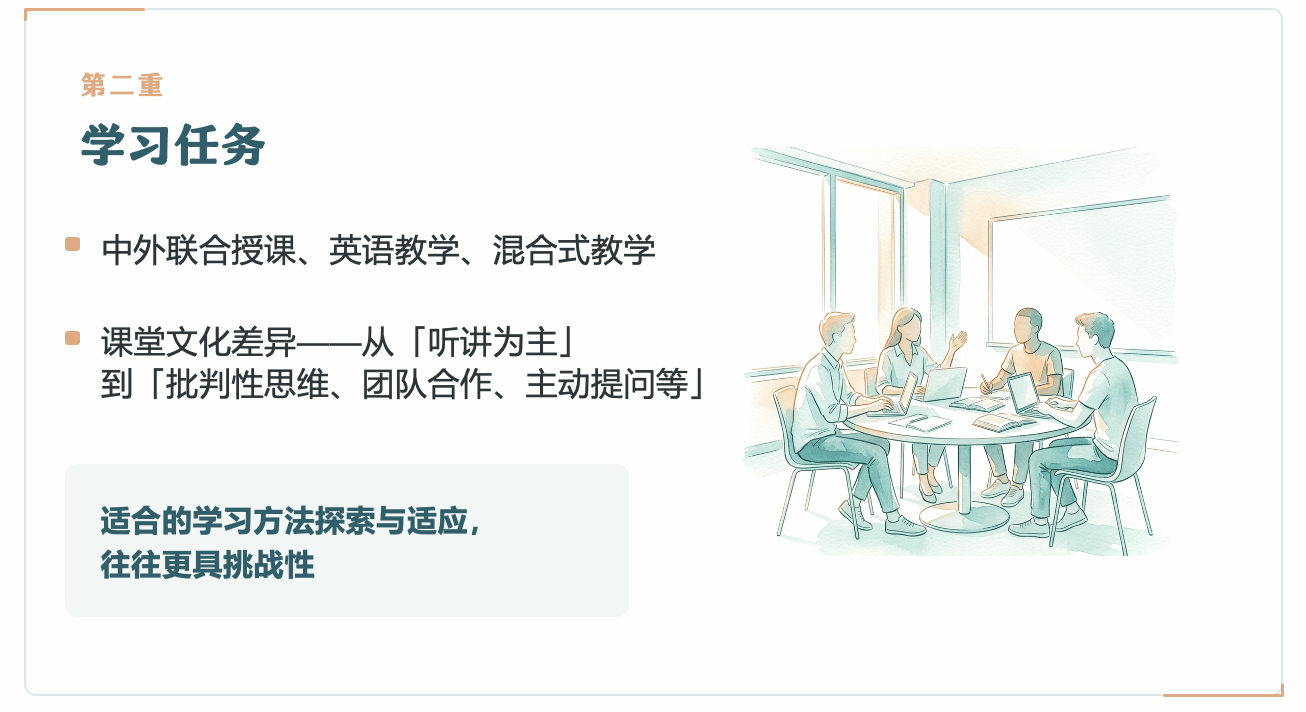
Understanding the Children: Four Dimensions of Adaptation — Challenges as well as Growth. Adapting to a new identity and a new study-and-life environment is a necessary stage of growth for every new student upon enrollment. From four dimensions — living environment, learning tasks, interpersonal communication, and future planning — Ms. MA presented to the parents a true picture of the students' study and life on campus. Helping parents see, understand, and truly know their children is precisely the essential premise of empathy-based, in-depth communication.
Understanding Themselves: Parents' "Empty-Nest Adaptation" Deserves Equal Attention. After a child leaves home for university for the first time, some parents may experience complex emotional fluctuations and a shift in their identity and role. Such adaptive responses are normal reactions to the "empty-nest stage." With respect to their children, parents need to complete the transition from "manager" to "supporter"; with respect to themselves, they may redirect the focus of their lives toward emotional self-regulation, rebuilding the rhythm of daily life, expanding their sense of meaning in life, and nurturing other close relationships. Parents in a healthy and positive state of body and mind can provide a steady anchor of support for their children, and, through their own example, exert a positive influence on them.

Learning Parent–Child Communication: Letting Go without Letting Loose; Caring without Controlling. What is to be let go is the child's decision-making authority and room for trial and error in personal growth during early adulthood; what must not be let go is the bond of parent–child affection, together with the necessary guidance and supervision concerning the child's values, sense of right and wrong, and safety bottom lines. Centering on this sense of balance, Zixuan MA, drawing on the psychological development characteristics of college students, shared three principles of communication — "ask more and lecture less, listen more and blame less, encourage more and criticize less" — along with five parent–child communication techniques: making good use of "curiosity questions," asking "And what else?", addressing emotions before solving problems, and negotiating the frequency of communication on an equal footing.

Family–School–Community Co-Education: Recognizing the Signals and Linking Up in Time. Students' psychological growth is a continuous process that calls for the coordinated efforts of families, schools, and professional resources, with safeguards in place at every stage. As mental health awareness spreads and deepens across society, the ability to recognize signals of mental health problems and to maintain an awareness of potential psychological crises has become an essential competency for schools, parents, and students alike. Drawing on her professional practice, Ms. MA compiled a checklist of warning signals that parents should watch for with vigilance, and introduced the university's psychological service channels as well as scientific and accredited mental health resources in the wider community. With families, schools, and society reaching out to one another — neither avoiding nor concealing — a stable and reliable psychological safety net can be built for every child.

Finally, Ms. MA extended her sincere wishes to the parents and freshmen: “May every new student of Hainan International College chase the light here in Hainan and live up to their prime years; and may every parent embrace this transformation with composure and live life with freedom and ease.” Going forward, the university will continue to roll out multi-level psychological education initiatives, providing sustained care for students as they grow and thrive. (Text: Zixuan MA)